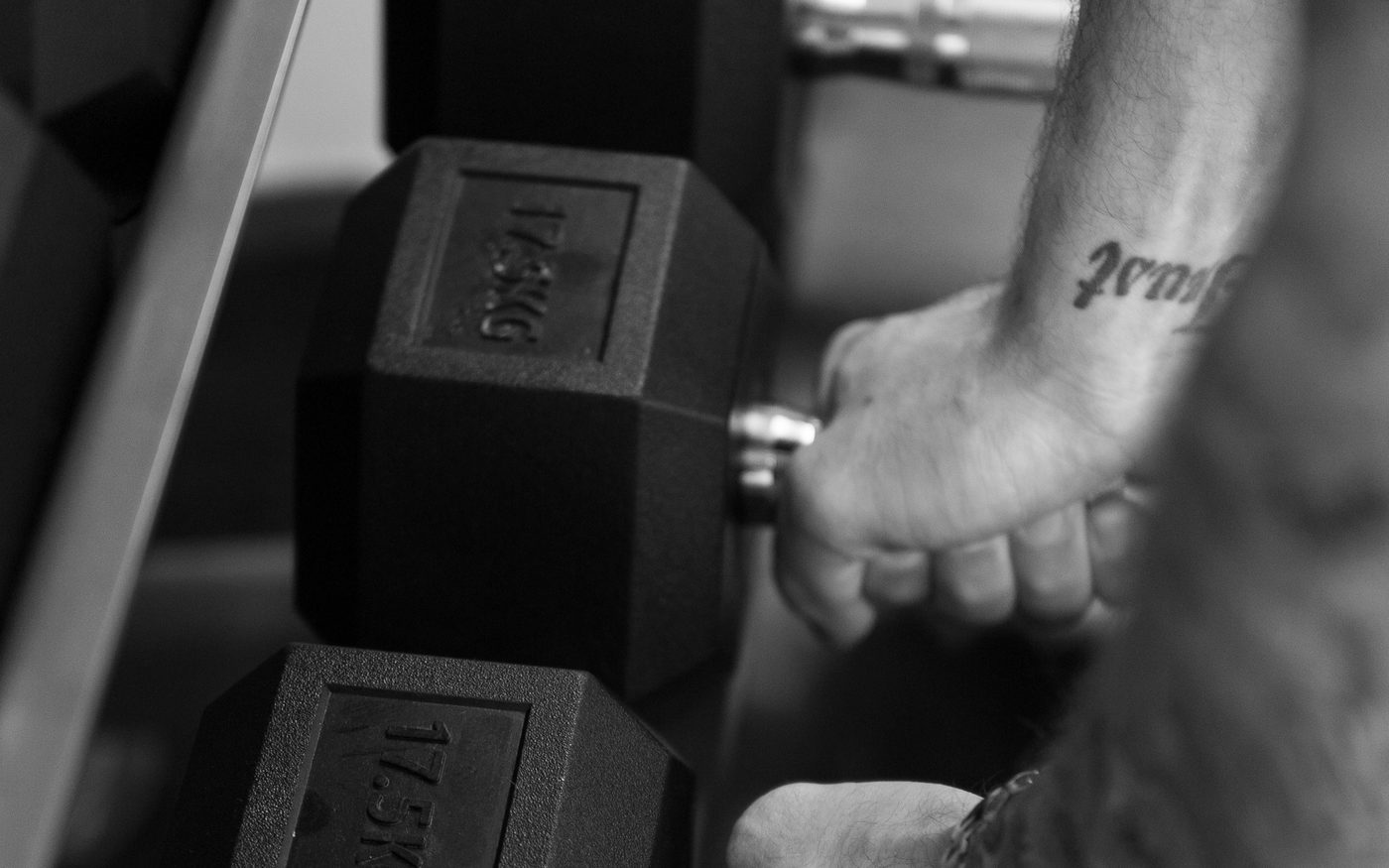
The gym is a blind spot for most runners. You know you need strength to avoid injury and maintain your posture at mile 22 of the Chicago Marathon. But execution usually fails in one of two ways. You either avoid the gym because you dislike the commercial environment, or you go and do high-rep endurance routines with light weights that just add fatigue to your legs.
Running is already an endurance activity. When you log 10,000 impacts per hour on a long run, your body does not need 3 sets of 20 reps with a 10-pound (5 kg) dumbbell. It needs to learn how to produce and absorb high levels of force in fractions of a second.
A 155-pound (70 kg) runner absorbs between 310 and 460 pounds (140 to 210 kg) of force per leg with every stride. To prepare your tissues for that load, you need to lift real weight. To do it specifically, consistently, and without leaving your house, a single, properly used kettlebell is enough.
This article details why the posterior chain is your running engine, why the kettlebell is the correct biomechanical tool to train it, and how to program your sessions to gain strength without adding a single ounce of unnecessary muscle mass.
The problem with endurance in the weight room
A distance runner’s intuition works against them when lifting weights. The logic is usually: "I am an endurance athlete, I should train strength with high repetitions." The result is a 15-to-20-rep circuit with light loads and short rest periods.
Physiologically, that stimulus is redundant. Your aerobic system and the local endurance of your slow-twitch muscle fibers already receive a maximum stimulus during your running sessions. Adding a light circuit at home does not increase your maximum strength, nor does it improve motor unit recruitment. It only depletes glycogen and leaves your legs heavy for the next day's interval session.
The strength a runner needs is neuromuscular. It consists of teaching the nervous system to recruit more muscle fibers in less time. You achieve this by moving heavy loads (for you) in the 3-to-6 rep range, or by moving moderate loads at very high speeds.
The posterior chain: the propulsion engine
When you run, your quadriceps act primarily as shock absorbers. They brake the impact and stabilize the knee. But the propulsion work—the force that pushes you forward and determines your speed and stride length—falls on the posterior chain: glutes, hamstrings, and calves.
Modern life and office work shorten your hip flexors and shut down your glutes. Many runners end up running "seated," overusing their quadriceps and shuffling their feet. This pattern worsens with fatigue and leads straight to knee overload.
Kettlebell training attacks this exact problem. Almost all fundamental movements with this tool revolve around the hip hinge. This motor pattern reactivates the posterior chain and teaches you to generate power from your center of gravity out to your extremities.
The mechanical advantage of the kettlebell
You could build strength with dumbbells, but the kettlebell offers three biomechanical and logistical advantages specific to running mechanics.
1. The offset center of gravity
With a dumbbell, the weight is distributed evenly around the handle. With a kettlebell, the weight hangs below and slightly away from your hand. This forces your core and shoulder stabilizing muscles to work twice as hard to maintain alignment through the full range of motion. Running requires exactly this type of dynamic stability.
2. Ballistic capacity
The kettlebell swing is a pure power exercise. You do not lift the weight with your arms; you launch it forward through an explosive contraction of the glutes and hamstrings. This rapid stretch-shortening cycle mimics the foot's contact and toe-off phase on the ground. No dumbbell exercise replicates this horizontal acceleration so cleanly.
3. Asymmetric load and anti-rotation
Running is a sequence of single-leg jumps. With every stride, your body must resist rotational forces to keep your torso facing forward. Working with a single kettlebell—loading it on one side of the body for squats, single-leg deadlifts, or carries—forces your obliques and quadratus lumborum to work in "anti-rotation" mode. This is the specific type of core strength that actually transfers to the road.
The three non-negotiable patterns
An effective program for runners does not need 15 different exercises. It needs to cover three fundamental patterns at the right intensity.
Hip Hinge
This is the foundation of posterior chain development. The movement occurs at the hip, keeping the shins almost vertical and the spine neutral. The primary exercise here is the single-leg Romanian deadlift (RDL). It works the hamstring eccentrically and demands ankle and knee stability. The swing is the ballistic version of this same pattern.
Single-leg squat
Classic bilateral squats are fine, but reverse lunges or Bulgarian split squats loaded with a kettlebell in the "rack" position (resting against the chest) expose strength asymmetries between your right and left leg. If you have a 15% deficit in one leg, running will eventually charge you for it in the form of an injury. Unilateral work corrects this.
Loaded carries
The suitcase carry consists of walking with a heavy kettlebell in one hand, keeping your shoulders and hips perfectly level. It is the most functional core exercise for a runner. If the weight pulls you to one side, the muscles on the opposite side must contract isometrically with every step.
How to program for strength without gaining bulk
The fear of gaining muscle mass (hypertrophy) and feeling heavy keeps many distance runners away from the weights. But hypertrophy does not happen by accident. It requires a caloric surplus and high training volume (many sets, many reps, prolonged time under tension).
To gain strength without mass, the rule is to keep the volume low and the intensity high.
- Reps: 3 to 6 per set.
- Sets: 2 to 4 per exercise.
- Rest: 2 to 3 minutes between sets. If you are breathing heavily when starting the next set, you are training your cardiovascular system, not your nervous system. Rest longer.
- Execution: Controlled eccentric phase (2 seconds lowering) and explosive concentric phase (standing up as fast as possible).
If you finish the session feeling muscle congestion (the classic bodybuilding "pump"), you are in the hypertrophy zone. A well-executed strength session leaves you feeling like you could have done a couple more reps per set. Your nervous system is activated, but you have no deep muscle fatigue.
When to fit strength into your week
The most common programming error is spreading fatigue evenly across the week. You run your intervals on Tuesday, and to "not overload the legs," you do your strength session on Wednesday, which was supposed to be your easy run day.
The result is that you are fatigued from intervals on Tuesday, you fatigue yourself with weights on Wednesday, and by Thursday you have not recovered. You never get a real rest day.
The golden rule in concurrent endurance training is to keep your hard days hard, and your easy days easy. The kettlebell session should fall on the same day as your quality running session (intervals, tempo, or threshold). Ideally, you run in the morning with fresh legs, and do your strength session in the afternoon. This makes the following day a genuinely easy day or a complete rest day, allowing your tissues to adapt.
During the base phase, two 30-minute sessions a week is the standard. In the final four weeks before a goal race (the taper phase), this drops to a single maintenance session to preserve muscle tension without accumulating residual fatigue.
The full routine, weights, and progression. Knowing which exercises to do is just the theoretical framework. Execution requires exact progressions, criteria for increasing weight, and adaptations based on your season phase.
The 12-week spreadsheet, complete with technical videos for each movement and load metrics, is an exclusive asset for athletes in the program. You can access it and download it right now in Triaperformance All-Access for US$39.99/mo.
The counterargument: "For real strength, you need an Olympic barbell"
Any traditional strength coach will read this and point out a real limitation: the absolute load of a kettlebell has a ceiling. If you want to push your back squat to 265 pounds (120 kg), you need a rack, an Olympic barbell, and plates. A 53-pound (24 kg) kettlebell will quickly fall short for generating adaptation in a bilateral squat.
The argument is mechanically correct. The Olympic barbell is the ultimate tool for absolute strength.
But context matters. For an amateur runner training between 6 and 12 hours a week, the metric that defines success is not absolute strength, but adherence and unilateral load transfer. Going to a commercial gym requires travel time, dealing with occupied equipment, and juggling schedules. A 35-pound (16 kg) or 53-pound (24 kg) kettlebell in your living room eliminates all logistical friction. The odds that you will actually complete your two 30-minute weekly sessions multiply by ten.
Furthermore, by working unilaterally (on one leg), a 53-pound (24 kg) kettlebell provides more than enough stimulus for most distance runners. It simultaneously trains the lateral stability of the ankle and hip—something a barbell resting on your back does not do with the same efficiency.
If you already have access to a well-equipped gym, solid barbell technique, and the logistics sorted out, classic heavy lifting is unbeatable. In that scenario, a pure maximum strength plan is the logical next step.
But if your current strength work consists of light circuits because you hate the gym, or you simply do nothing at all, the Olympic barbell is a theoretical solution to a practical problem. A single heavy kettlebell, mastered in the correct patterns and executed with intent in your own home, is the shortest bridge between the runner you are today and the resilient runner you need to be on race day.