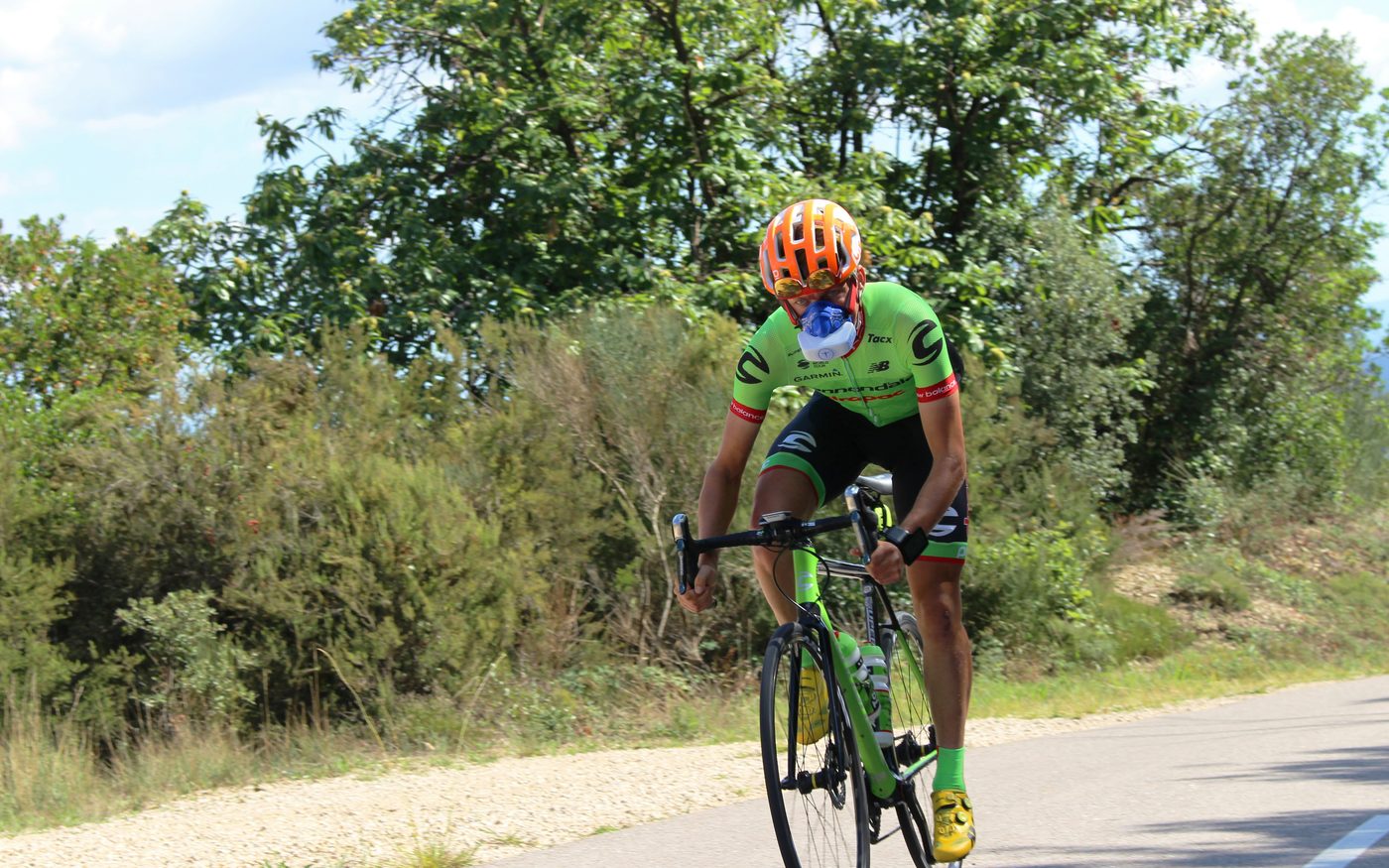
Zone 2 Cycling for Fat Loss: Why More Volume Does Not Equal More Fat Oxidation
Most weight loss advice tells you to ride more, but missing your exact intensity cap by just 10 watts is enough to shut down fat oxidation entirely.

Data-driven training: how to choose, how to measure, and what to do with the numbers.
No articles on this topic yet.
Most weight loss advice tells you to ride more, but missing your exact intensity cap by just 10 watts is enough to shut down fat oxidation entirely.

A foam roller won't release your IT band. Lateral knee pain is a mechanical issue of pelvic drop, and the solution requires eccentric strength, not massage.
Pelvic drop destroys your running economy. Why bilateral balance metrics are useless if you keep doing traditional crunches instead of stabilizing your chassis under fatigue.
Your watch says you're exhausted, but it doesn't explain why. Learn how to cross-reference heart rate, pace, and perceived exertion to diagnose the source of your fatigue and adjust your training.
You calculate your threshold in the pool, but on race day you swim 15 seconds slower per 100 meters. We break down the hydrodynamic impact of sighting and wetsuit restriction.
The FTP you measure on the indoor trainer is lying to you in the mountains. Here is why sustaining the same power at a low cadence destroys your legs, and how to recalculate your zones.
How to transfer the speed you built in shorter races to half marathon endurance without falling into the junk mileage trap.
A step-by-step strategy to modulate tendon stiffness through heavy slow resistance without losing your aerobic base.
A specific tactical guide for South America's fastest course: how to structure your 12 or 18 weeks to survive the humidity and the headwinds of the final stretch.
Competitors offer generic rest advice, but never show the real roadmap of an amateur athlete who loses 8 key days of preparation. Here is how we applied our decision rules to save the race and achieve a PR on the bike.
The 5K is short enough to invite mistakes and long enough to expose anyone who started too fast. Here is how to structure your pacing.
A quick neuromuscular sequence to wake up the gluteus medius and maximus before easy runs and interval sessions, preventing hip flexor and knee overload.
Pro micro-intervals rely on a 25-hour weekly aerobic base. Replicating them on 8 hours a week triggers autonomic overload, not mitochondrial density.
A general core routine won't help you sustain lumbar flexion in the aero position. Here is how to stabilize your hips on the bike without compromising your run.
How to use targeted low-cadence tempo intervals to stimulate myofibrillar tension, preserving muscle mass while maintaining an energy deficit.
After demanding sessions, your sympathetic tone remains elevated, preventing restful sleep. This 5-minute protocol accelerates parasympathetic activation.
How to plan your mileage progression for 26.2 miles while managing heat stress and maintaining true aerobic density.
Competitor full-distance guides push generic plans requiring 18 to 22 hours weekly, ignoring professional and family realities. Here is how to achieve sub-11h readiness on a strict 14-hour ceiling.
TrainingPeaks confirmed HYROX is an endurance event, but provided zero running periodization guidance — here is the physiological blueprint to protect your race pace off the sleds.
We explain how to program short repetitions versus 20 to 30-minute tempos to maximize your time in Zone 4 without triggering excessive cardiac drift.
Real analysis of power data, fatigue management, and how weekly loop rules unlocked the performance of stagnated master athletes.
How to structure a 12 to 14-hour weekly microcycle for an Ironman without falling into overtraining.
A practical explanation of anaerobic work capacity and how to predict the exact moment your pace will collapse on a climb.
Your stomach trains exactly like your legs. A structured protocol to tolerate 90g of carbohydrates per hour under the stress of race pace.
Amateur runners turn easy base miles into moderate workouts, accumulating fatigue without physiological benefit and ruining their quality sessions.
Your aerobic system adapts faster than your joints. How to use eccentric strength to match your knee capacity with your lung capacity.
Postural fatigue in triathlon comes from a posterior chain collapse, not a lack of traditional sit-ups. This is the isometric progression to sustain hours in the aerobars.
It's the metric I use most when giving feedback, and the one that generates the most questions. What the number means, when it's valid, and how to use it to know whether the pace of that session was right for that duration.
TrainingPeaks published age group volume data. Here is how a real amateur triathlete managed his load to qualify for the World Championship by applying strict adjustment rules.
We analyze the real case of a triathlete who accumulated excessive fatigue mid-block, and how applying our adjustment rules saved his peak fitness without canceling the cycle.
The trend of accumulating threshold time without daily lactate testing leads recreational cyclists to overuse and stagnation. Here is how to adapt the model for real life.
Instead of slow recoveries, intervals with float recovery force your body to metabolize lactate at race pace, building real tolerance for 26.2 miles.
A single 20-minute test gives an isolated FTP number that ignores your functional reserve capacity and your durability when fatigued.
Tracking your sleep data changes nothing unless you have a mechanical lever to force your overnight heart rate down.
Software calculates your threshold based on the past, but your physiology responds to today. How to use breathing and perceived effort to save a session when the prescribed pace does not fit.
We show how our mathematical adjustment rules alter a training block when pain occurs, rather than relying on generic advice to push through.
Calculators give you a generic percentage of your FTP. Here is how we use physiological decoupling to set a power target that protects your legs for the final 26.2 miles.
Standard calorie restriction makes you a lighter, slower runner; a structured plan uses fat-max running, strength training, and targeted fueling to change your body composition while protecting your performance.
The technical debate about power threshold ignores the real problem: your FTP is useless if it collapses after 2000 kilojoules of work.
"Unproductive". "Strained". An easy hour the watch logs as zone 5. Almost always the problem is not your fitness — it is the zones the watch invented.
Stepping up to the full distance is not about multiplying your mileage by two. It is about redistributing weekly impact to build durability without overtraining.
The biggest obstacle in HYROX is not the running volume, but running 1 km with muscular congestion after the sleds. This is how you structure compromised running blocks.
Why relying solely on heart rate ruins your intervals, and how to use power and perceived exertion to stay on target.
Valencia's flat profile invites you to start too fast. We analyze the conservative negative split strategy, aid station management, and carb-loading.
We extract the high-yield physiological habits from WorldTour coaching methods and filter out the pro volume demands.
Physiology explains why your stomach shuts down at 86°F (30°C), but on race day, you need exact rules to adjust your pace and carbohydrate intake per hour.
We evaluate the professional trend of consuming 120 grams of carbohydrates per hour from an amateur's physiology, the digestive risk, and how to transition safely.
The marathon is booming, but amateur runners are failing the basic math of fatigue. Understand how to build volume without breaking down before the start line.
We demystify threshold statistical models to give you a testing system you can actually execute on the road or the indoor trainer.
How to develop your posterior chain at home with minimal equipment, without gaining muscle mass that slows your race pace.
A definitive guide to calculating your threshold power and structuring your running zones without relying on laboratory tests.
Before committing to 24 weeks of training, you need to assess if your body can absorb the mathematical load demanded by the full distance.
The taper clears fatigue, but it also shuts down your neuromuscular system. Here is how to wake up your body without wasting race energy.
The Norwegian method's intensity control doesn't require pricking your finger on the track if you understand how to adjust your physiological zones in real time.
Absolute rest weakens the tendon. The 24-hour rule and the mechanical loading protocol to decide when to stop and when to keep going.
The gap between an elite training plan and an amateur's isn't just total volume—it is how the schedule adapts when life inevitably gets in the way.
None of the traditional endurance platforms address hybrid formats. We bridge HYROX conditioning with standard running volume for optimal body composition.
How high-mileage and masters athletes can synthesize daily nutrition, creatine, and sleep architecture into a unified recovery protocol.
The most common mistake in marathon prep is not running too slowly. It is copying the weekly mileage of people who run for a living.
A practical blueprint showing how to structure Zone 2 rides and caloric deficits without crashing your recovery or losing power.
Adding more miles to a running plan for weight loss usually results in metabolic adaptation, muscle loss, and a stubborn plateau. Here is how to structure it properly.
The collapse in the final third of the marathon is not mental. It is a metabolic failure you prevent by managing load and nutrition.
A flat profile and a December race date require a precise decision on the length of your specific training block to avoid arriving at the start line overtrained.
One 30-minute test gives you the number. Your seven zones and the two sessions that move threshold all come from it.
Four questions and you're down to one plan. No guessing, no buying twice.