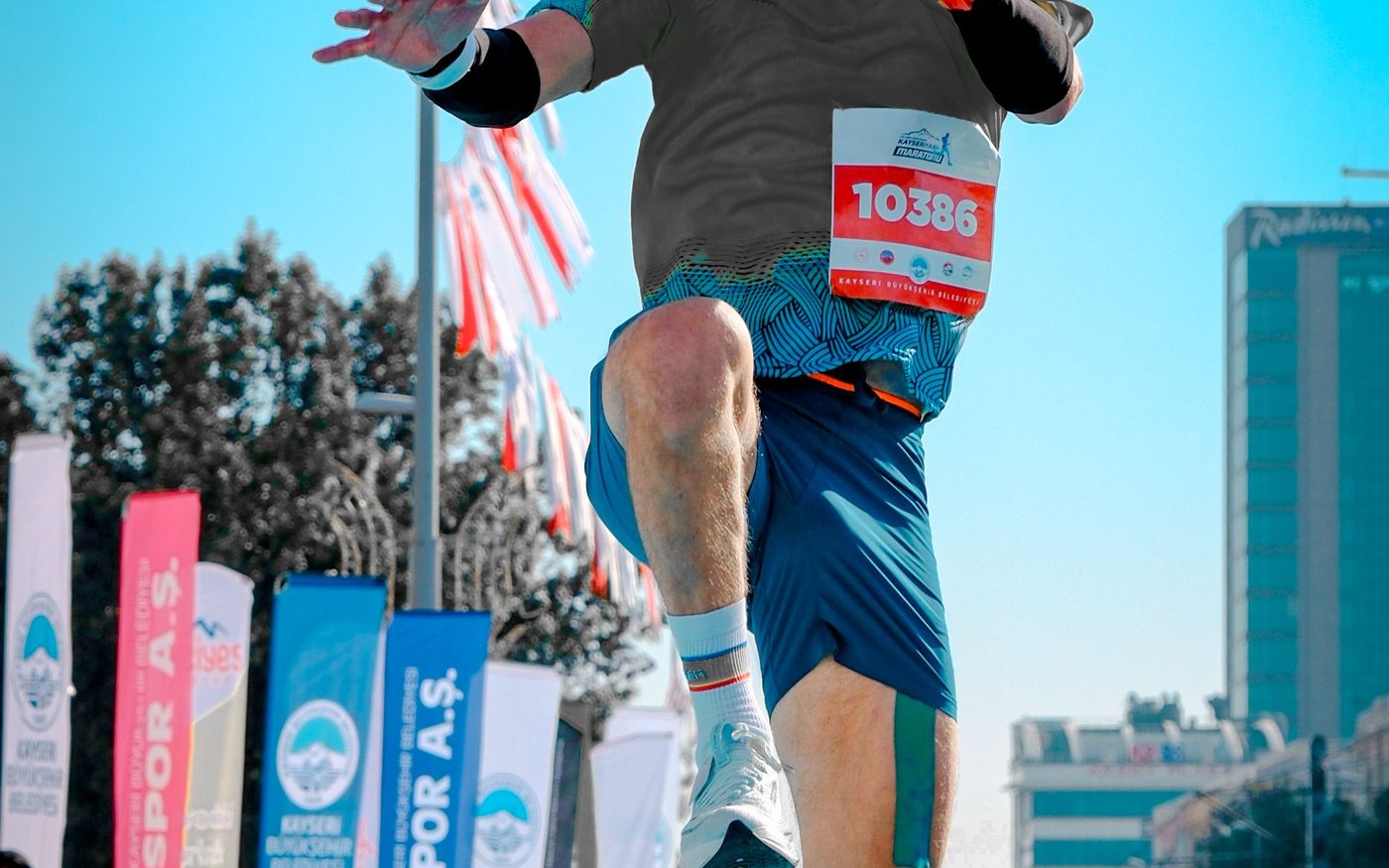
You spend eight hours sitting at a desk. Your hip flexors shorten, your pelvis rotates, and your nervous system arrives at a basic efficiency conclusion: if you aren't using your glutes for anything, it's better to turn off the signal that contracts them. This is called reciprocal inhibition.
Then, at 6:00 PM, you put on your running shoes and head straight out to hit your threshold pace. Your brain sends the command to extend the hip to move forward, but the gluteus maximus doesn't respond fast enough. The body, which always finds a way to get the job done, shifts that load to the hamstrings and the lower back. Thirty minutes later, your pace is holding steady, but your mechanics are broken, and the fatigue cost of the session has just doubled.
Pre-run glute activation is not a strength workout. It isn't chasing hypertrophy or muscular endurance. It is a neuromuscular reminder. It consists of 8 minutes of specific work to ensure the primary running muscles are fired up before you take your first step, protecting your knees and optimizing your stride.
The anatomy of a sleepy glute
For a runner, the glutes serve two non-negotiable mechanical functions that cannot be replicated by any other muscle group without generating harmful compensations.
Gluteus maximus: The propulsion engine
It is the largest muscle in the body and the primary driver of hip extension. When your foot strikes the ground and pushes back to propel you forward, the gluteus maximus should be the star of the show. If it's inhibited from hours of sitting, the hamstrings take over. The problem is that the hamstrings cross two joints, and their primary function is not pure loaded extension. The direct result of this compensation is hamstring overload and lower back pain.
Gluteus medius: The pelvic stabilizer
Running is essentially a series of linked single-leg bounds. During the flight phase and landing, your entire body weight lands on one foot. The gluteus medius is responsible for keeping your pelvis level during that fraction of a second. If the gluteus medius fails, the opposite hip drops. To keep you from falling, your femur rotates inward and your knee collapses toward the center (knee valgus). This friction, repeated 160 times a minute, is the root cause of iliotibial (IT) band syndrome and patellofemoral pain.
Waking up both muscles takes less than 10 minutes if you know how to structure the right sequence. If you don't, you will spend weeks dealing with knee pain and looking for answers in compression sleeves that don't address the root problem.
Execution rules: Activation vs. fatigue
The most common mistake with pre-run routines is turning them into a conditioning circuit. If you finish the sequence sweating, with your legs shaking or feeling a deep burn in your muscles, you went too far. You just wasted energy you needed for your main session.
Activation is governed by these three rules:
- Low load, high intent. Movements are done with your own body weight or a light resistance band. The key is the mind-muscle connection. You must feel the glute contracting; if you feel the work in your quads, your posture is wrong.
- Short volume. Between 10 and 15 reps per side are enough to light up the nervous system. Higher reps generate peripheral fatigue.
- Positional progression. The sequence should move from the floor (where you isolate the muscle without requiring balance) to standing (where you integrate the activation into a movement pattern similar to running).
The 8-minute sequence
This is the methodological structure we use. It is divided into three phases that progress from pure isolation to running-specific elasticity.
Phase 1: Floor isolation (3 minutes)
Here, we remove gravity and balance from the equation to force the brain to communicate exclusively with the glute.
Glute Bridge: Lying on your back, knees bent. The technical detail is in the pelvis: before lifting, perform a posterior pelvic tilt (flatten your lower back against the floor). Then, push through your heels until your knees, hips, and shoulders are aligned. If you feel tension in your hamstrings, bring your feet closer to your glutes. If you feel tension in your quads, move them further away.
Clamshell: Lying on your side, knees bent at 90 degrees. Keeping your heels together, lift the top knee. The range of motion is short. If your hip rolls backward to open the leg further, the exercise loses its effect on the gluteus medius, and the tensor fasciae latae (TFL) takes over.
Phase 2: Standing integration (3 minutes)
Once the muscle knows how to contract, we need to teach it to do so while supporting your body weight, which is what will happen out on the road.
Monster Walks (Lateral Band Walks): Place a light resistance band just above the knees. Get into an athletic half-squat position. Take lateral steps without letting the band snap your knees together abruptly during the return phase. The movement must be controlled in both directions. The gluteus medius of the stationary leg works just as hard as the moving one.
Single Leg Hinge: Standing, balance on one leg with a very slight knee bend. Push your hips back while keeping your back straight, as if you were trying to touch the wall behind you with your glutes. This movement integrates hip extension with ankle and knee stability.
Phase 3: Dynamic elasticity (2 minutes)
The final bridge between muscle activation and the act of running. Here, we slightly elevate the heart rate and prep the tendons for the stretch-shortening cycle.
Pogos: Short, fast jumps in place with knees nearly locked, bouncing from the ankles as if the ground were on fire. This preps the Achilles tendon and calf musculature.
A-Skips: Alternating high knees with a quick, reactive ground contact. Coordinate your arm swing and integrate the hip extension of the stance leg with the flexion of the driving leg.
The ready-to-execute routine, right on your phone.
Knowing the theory is useless if you end up doing two static stretches before heading out because you forgot the order of the exercises. The dynamic activation artifact—an 8-minute audio/video with precise timings, rests, and technical cues to hit play in the hallway before your run—is part of our exclusive resource library.
The athletes inside our membership use it as a mandatory protocol before every quality session. You can access this resource and all our structured plans through All-Access.
The impact of activation on your training zones
The mechanical efficiency you gain with glute activation directly impacts how you absorb your training plan. At Triaperformance, we use a polarized 7-zone model (1, 2, X, 3, Y, 4, 5). The state of your musculature dictates how your body responds to the key intensities of this model.
The real cost of Zone 2 and the Zone X trap
Your aerobic runs should fall in low Zone 2. The goal of this zone is to accumulate volume with a very low structural fatigue cost. However, if you run 60 minutes in Zone 2 with an inhibited gluteus medius, the stress on your knees and tendons multiplies. What was physiologically a Zone 2 effort mechanically carried the cost of a much harder session.
This subtly pushes you toward the effects of Zone X (the upper half of Zone 2, close to marathon pace). This is a band we avoid prescribing for easy runs precisely because it accumulates a lot of fatigue without delivering a superior aerobic benefit. Running with poor technique due to a lack of activation generates that same unnecessary wear and tear. You arrive at interval day with dead legs—not from excess intensity, but from mechanical friction.
Performance in threshold work
When we prescribe the two sessions that push your threshold upward—the Extensive (30 minutes sustained just below threshold) or the Intensive (15-minute blocks right at or slightly above it)—the strength demand changes.
Sustaining a high intensity for 30 minutes requires powerful, consistent hip extension. If your gluteus maximus isn't contributing its share of power, your hamstrings will burn out prematurely. You won't slow down because your cardiovascular system collapses or because your pace zones are miscalculated; you will slow down because your legs feel like cement at minute 18. Activating before these sessions ensures the main engine is online when the workout demands it.
The return protocol after a break
The importance of activation is so high that we integrate it as a hard rule in our return protocols. After a period of inconsistency, a work trip, or an illness, your threshold drops and your mechanical tolerance disappears. The first two weeks of returning are programmed exclusively with easy runs in Zone 1 and 2, but with a strict mandate: pre-run activation is mandatory. It is the only way to reload the tendons without triggering reactive tendinopathy.
Why the first easy mile doesn't replace activation
The most common objection to pre-run routines is time. There is a widespread belief that starting with a very slow jog for the first 10 minutes serves the exact same warm-up function.
It's true that a light jog raises your body temperature, increases blood flow, and lubricates your joints. But on a neuromuscular level, jogging slowly with an inhibited glute just means you are going to take a thousand steps reinforcing a dysfunctional motor pattern. If your brain has shut off the connection to your glute after eight hours in a chair, starting to run isn't going to magically turn it back on. You will simply run slowly using your hamstrings and lower back.
Activation requires an isolated, conscious stimulus that continuous running does not provide. Investing 8 minutes in your hallway before starting your GPS watch is the difference between a run that adds to your progress and one that slowly grinds down your knees. Biomechanics aren't fixed with slow miles; they are fixed with intention before you take your first step.