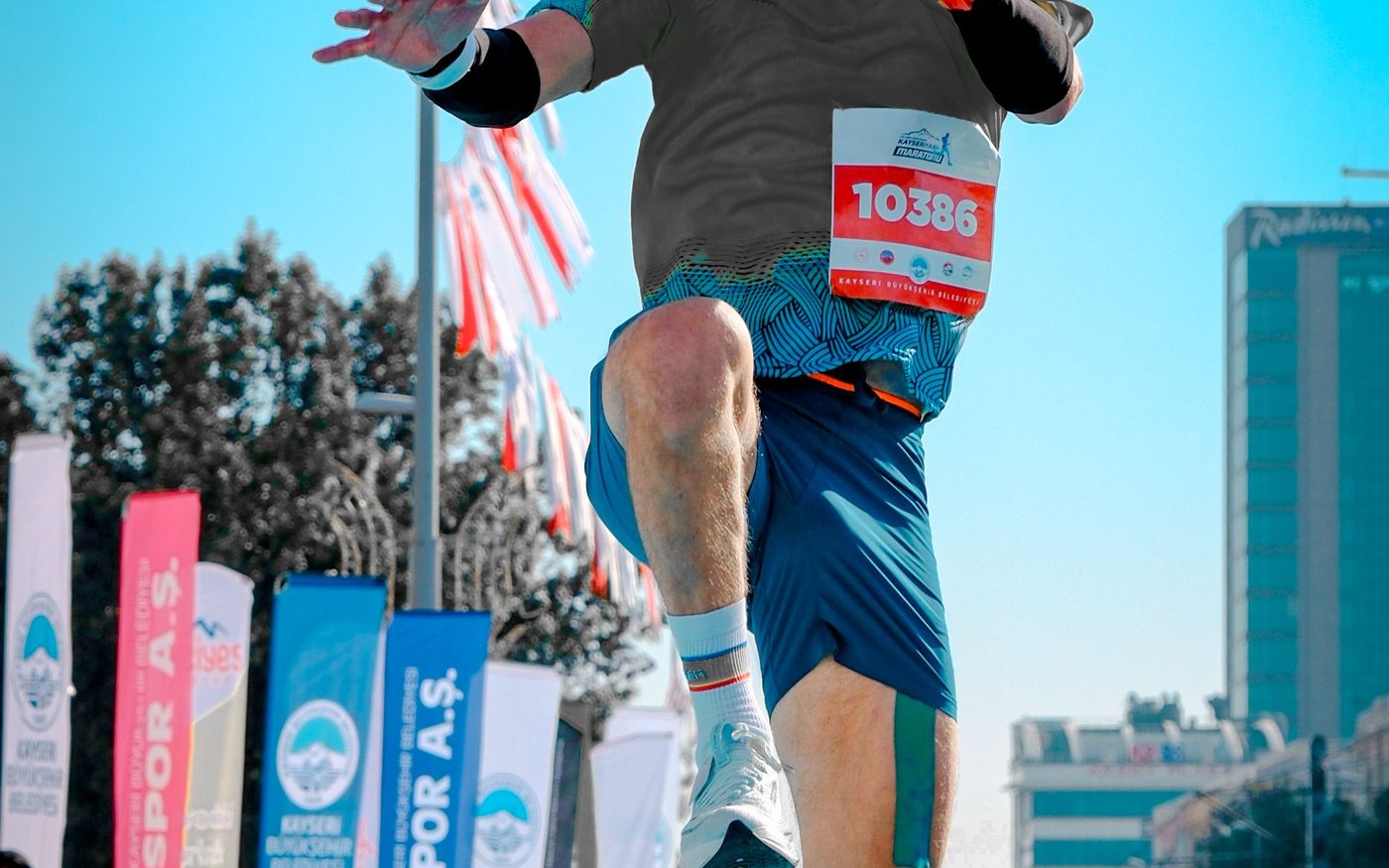
The Valencia Marathon has a data-backed reputation. It is flat, the tarmac is fast, the December weather is usually cold at the start, and the high density of fast runners pushes you forward. Everything on this course is designed for running fast.
That is its biggest advantage. It is also the trap that ruins 50 percent of amateur races.
A completely flat course means your stride does not change. There are no climbs to force a shorter step, no descents to shift the dominant muscle group. You use the exact same muscle fibers for 35,000 consecutive impacts. If you start 5 seconds per kilometer (8 seconds per mile) faster than your actual capacity because "you feel good," mechanical wear collects the debt at kilometer 32 (mile 20).
Running well in Valencia requires no magic. It requires discipline in the first half, a mathematical carbohydrate intake, and an execution plan you respect no matter who passes you in the first 10 kilometers.
The strategy: conservative negative split
Pacing is not running the same pace from the gun to the finish line. It is managing fatigue so your target pace remains sustainable when the body starts to fail.
In our methodology, the average pace of a marathon should fall into zone X — the upper half of your zone 2. It is a high aerobic effort that accumulates fatigue over the hours. To manage it, we execute a conservative negative split: aiming for a second half slightly faster than the first, saving maximum effort for the final stretch.
The race is divided into three technical blocks.
Kilometers 0 to 21 (Miles 0 to 13.1): the floor pace
The first half is run at your floor pace. This is the lower limit of your target pace range. If your goal is to average 5:00 min/km (8:03 min/mile), your floor pace is 5:05 min/km (8:11 min/mile).
During these 21 kilometers, the perceived effort must be deceptively easy. You need to feel like you are holding back. The adrenaline of the start, the crowds, and the taper will make you believe you can go 15 seconds per kilometer (24 seconds per mile) faster. Ignore that feeling. You are buying the right to run hard later.
Kilometers 21 to 30 (Miles 13.1 to 18.6): hold and evaluate
You cross the half marathon mark and adjust the pace to your exact target average. Here, perceived effort begins to rise, but your heart rate should remain stable. This is the stretch where the nutrition you took in the first two hours starts to dictate your future.
Your only task in these nine kilometers is to maintain cadence and reach kilometer 30 without touching your emergency reserves.
Kilometers 30 to 42 (Miles 18.6 to 26.2): the real race
The 70 percent distance mark is the turning point. If you executed your pacing and nutrition correctly, this is where you push.
You stop checking your watch every kilometer and transition to running by effort. The goal is to sustain the pace or chase that negative split to shave seconds off the clock. Your heart rate will climb toward zone Y (just below threshold), and that is fine. It is time to empty the tank. You will see hundreds of runners walking; you maintain form.
Nutrition and on-course aid stations
Perfect pacing collapses without glycogen. Carbohydrates rule. In the marathon, the goal is to ingest up to 60 grams of carbohydrates per hour.
You do not test your stomach's tolerance on race day. You train it during the preceding months. If you run without fuel, the body shifts to fat oxidation, a far less efficient process that forces you to drop your pace drastically.
The race protocol:
- Carbohydrates: 60g/h. In practice, this usually means a 20g gel every 20 minutes, or a 30g gel every 30 minutes.
- Sodium: Approximately 200mg every 40 minutes. Valencia is usually cool, but Mediterranean humidity increases your sweat rate.
- Caffeine: 200mg before the start. If you are trained to tolerate it, you can add smaller doses in your second-half gels.
How to use Valencia's tables
The Valencia organization places aid stations every 5 kilometers. This dictates your logistics. You do not need to carry a heavy hydration vest on a flat, sea-level course with tables this frequent.
The rule is simple: you carry the gel, the race gives you the water. Sync your gel intake so it happens about 200 meters before you reach the aid station. You take the gel, wash it down with a cup of water from the organization, and keep moving. Never mix a gel with an on-course isotonic drink; the carbohydrate concentration in your stomach will be too high and cause gastrointestinal issues.
Final preparation: loading and tapering
Sunday's execution depends on what you do starting Thursday. Carbohydrate loading is not eating an extra plate of pasta the night before. It is a mathematical 48 to 72-hour protocol.
Three days before the race, you cut fiber. No vegetables, no whole fruit, no whole grains. You want to empty the intestinal tract to avoid dead weight and digestive problems. During the final 36 hours, the goal is to ingest up to 10 grams of white carbohydrates per kilogram of body weight, paired with lean protein. If this is your first marathon and you are not accustomed to this volume, start at 5g/kg and progress in future competitions.
The taper: managing the mind
The build phase ends three weeks before the race with your highest volume week. The final two weeks exist for a single purpose: eliminate accumulated fatigue while maintaining the minimal stimulus necessary to not lose fitness.
The psychology of the taper is predictable. You will feel heavy, easy runs will feel difficult, and you will have the irrational urge to run a hard session to "prove" you are fit. Do not do it. The work is done. Arriving with a positive Training Stress Balance (TSB) is the technical goal of these two weeks.
The lead-up: 12 to 18 weeks of specificity
A good execution plan does not save a bad training cycle. Searching for a Valencia marathon training plan online usually returns generic templates based purely on accumulating mileage.
Real preparation requires specificity. Volume must be balanced with the correct intensity in the proper zones. Spending three days a week running in zone X during training leaves you with dead legs for the actual quality sessions, a common mistake in amateur preparation.
The 42k Catalog: At Triaperformance, we offer structured marathon training plans based on heart rate, ensuring you work in the correct zones for your level and schedule. You can access our 12- and 18-week marathon blocks through our All-Access subscription for US$39.99/mo, which includes every plan in the catalog.
12 Week Marathon Peak: Heart Rate 💓 (Advanced Vol: 110km+)
12-week peak plan for advanced runners
US$ 49.99
The counterargument: the even split myth
The most common objection to the conservative negative split strategy is looking at the elites. The runners who win in Valencia run an even split — they nail the first half in 62 minutes and the second half in 62 minutes.
This is a fact, but it does not apply to your race. Elite athletes complete a marathon in just over two hours. At that level, they are running at intensities very close to their critical threshold for the entire event. Their limiter is purely metabolic.
For an amateur runner who takes three or four hours, the primary limiter in the final 10 kilometers is not the cardiovascular system, it is peripheral muscle fatigue. The mechanical damage of sustaining impact against the tarmac for over three hours destroys running economy.
Starting a few seconds slower in the first half drastically reduces that early peak in muscle damage. It protects you. It allows your legs to keep responding to your brain's commands at kilometer 35 (mile 22). The even split is the optimal strategy in a lab; the conservative negative split is the strategy that survives the tarmac.